Exception与Error的区别解析(源代码的注释)
ExceptionThe class Exception and its subclasses are a form of Throwable that indicates conditions that a reasonable application might want to catch.Th
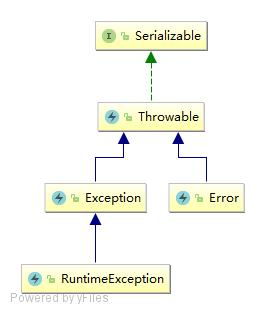
Exception
The class Exception and its subclasses are a form of Throwable that indicates conditions that a reasonable application might want to catch.
The class Exception and any subclasses that are not also subclasses of RuntimeException are checked exceptions. Checked exceptions need to be declared in a method or constructor's throws clause if they can be thrown by the execution of the method or constructor and propagate outside the method or constructor boundary.
RuntimeException
RuntimeException is the superclass of those exceptions that can be thrown during the normal operation of the Java Virtual Machine. RuntimeException and its subclasses are unchecked exceptions. Unchecked exceptions do not need to be declared in a method or constructor's throws clause if they can be thrown by the execution of the method or constructor and propagate outside the method or constructor boundary.
Error
An Error is a subclass of Throwable that indicates serious problems that a reasonable application should not try to catch. Most such errors are abnormal conditions. The ThreadDeath error, though a "normal" condition, is also a subclass of Error because most applications should not try to catch it. A method is not required to declare in its throws clause any subclasses of Error that might be thrown during the execution of the method but not caught, since these errors are abnormal conditions that should never occur. That is, Error and its subclasses are regarded as unchecked exceptions for the purposes of compile-time checking of exceptions.